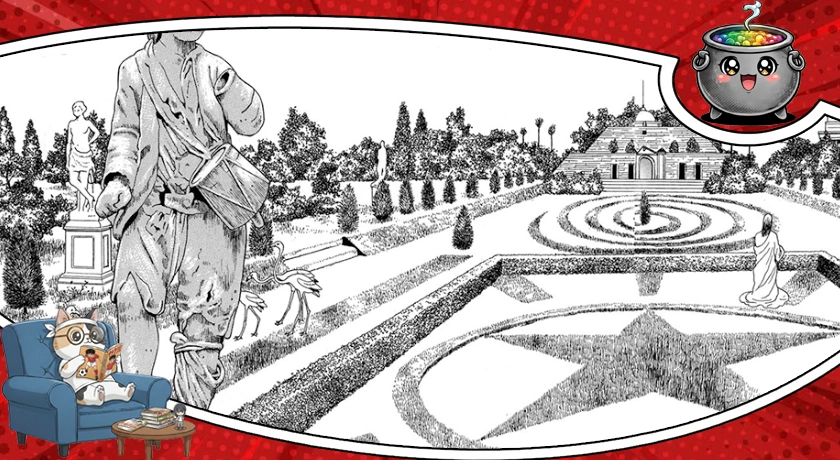
Imagine an island on which Greek gods, sirens, and ephebs participate in an endless orgy among unreally beautiful landscapes. Such content can be found in the one-volume manga Mysterious history of Panorama Island from Waneko, which really surprises and provokes reflection.
Manga tells the story of Hirosuke Hitomi, a subordinate science fiction writer whose life seems to be a series of failures. He is deeply distressed by Edgar Allan Poe's work and dreams of creating the perfect world. Surprisingly, he learns about the death of a wealthy childhood friend, whom he is extremely similar to. This gives rise to certain opportunities for his dreams. He decides to take over his identity and start a new life. Hirosuke becomes the new heir to the estate of Komoda. With unlimited resources, he pursues his greatest dream: he builds the island of Panorama. A paradise full of luxury, eroticism and fantastic landscapes, where the boundary between sleep and reality blurs in a frighteningly beautiful way. However, his Eden hides many dangers and moral traps, and the consequences of deception inevitably begin to catch up with him.
Manga Mysterious History of Panorama Island It's a very unusual and very specific position. The title is broken down by unambiguous species classifications. This position forms a bridge between classical crime literature, psychological drama and radical comic avant-garde with elements of explicit eroticism. Manga is based on a novel by Edogawa Ranpo, called by many Japanese Poe. Suehiro Maruo, known as the king of the ero-guro genre, this time drowns his love to empathize with extreme mountains in favor of the dense, iniric atmosphere of the original novel.
The author of the manga really reflects the decadent atmosphere of the song, in which the protagonist's dreams of the perfect world become a fascinating, though disturbing, reality. From the first pages the reader is drawn here into the psychologically complex and distorted world of Hirosuke, full of anxiety, obsession and ambiguous evil.
The beginning of the story is slow and full of tension, which allows the reader a little better understanding of Hirosuke's motivations. However, in the second part of the manga explodes visually and thematically. The island, the epicentre of the hero's dream, becomes a place of erotic fantasies, delights and grotesque deviation. Maruo is not afraid to show the human body in its fullness, so it is a position only for adult readers. Sexuality and nakedness are not, however, a vulgar and integral part of the narrative. On the one hand, they attract the attention of the reader, on the other, they build the atmosphere of the island, where the limits of morality and decency are blurred.
Mysterious History of Panorama Island is also well constructed from a narrative angle. The story, although at first glance simple, turns out to be deeply multilayered. We observe the moral fall of a hero who, for the realization of his own vision, does not retreat from breaking all ethical norms. The desecration of the grave, the deception. All these acts are shown in a suggestive way, provoking to reflect on the price of human ambition and limits of morality.
Panorama Island, as the central point of manga, is a conceptual masterpiece. Maruo brilliantly reflects Baudelaire’s idea of an artificial paradise. It's a place where nature has been completely subjected to technology. Where perspective is cheated by painted panels, and residents are just paid statists playing roles in great, hedonistic art. The reader is drawn into this illusion. The initial delight over gardens and palaces, however, quickly subsides the place of shortness of breath and claustrophobia. The author asks a fundamental question: can beauty based on mechanical manipulation and crime be true?
Nie można tu jednak również nie wspomnieć o pewnych niedoskonałościach mangi. Przewracając kolejne strony, na pewno dostrzeżemy umowność niektórych faktów oraz trudne do zrozumienia czyny bohatera. Są chwile kiedy działania czy wydarzenia są tak irracjonalne, że wpływają na ogólny klimat tytułu. Ponadto zakończenie mangi jest nagłe i nieco niejasne, pozostawiając odbiorcę z pewną dozą niedosytu.
Niczego złego na pewno nie można za to napisać na temat warstwy graficznej. Rysunki Suehiro Maruo zapierają tu dech w piersiach. Każdy kadr jest przemyślany, pełen detali i bogactwa perspektyw. Krajobrazy, architektura, postacie. Wszystko świetnie oddaje dekadencką, surrealistyczną wizję wyspy – raju. Maruo wykorzystuje tu techniki, które pozwalają czytelnikowi poczuć się uczestnikiem wydarzeń. Panoramiczne ujęcia, szczegółowe sceny zbiorowe, misternie oddane dekoracje i roślinność sprawiają, że Wyspa Panoram ożywa w pełni. Jednocześnie, groteskowe przedstawienie ludzi, ich spojrzenia i deformacje twarzy, wprowadzają element niepokoju i sugestię, że za pozornym pięknem kryje się moralne zepsucie i groza.
Mysterious History of Panorama Island to więc manga wyjątkowa, ale na pewno nie trafi ona w gusta każdego. Jest to bowiem tytuł bardzo wymagający. Choć historia opiera się na prostym motywie zamiany ról, to jej wykonanie wynosi ją na poziom rzadko spotykany w komiksie głównego nurtu. To pozycja przeznaczona dla dorosłego czytelnika, który nie boi się spojrzeć w otchłań ludzkich fantazji i estetyki.
| PLUSY: | MINIUS: |
|
|
|
|
|
|
|
|
| Mangę do recenzji dostarczyło wydawnictwo Vaneko. Tytuł można również znaleźć na Katowice Comic Hall oraz Ceneo. |